
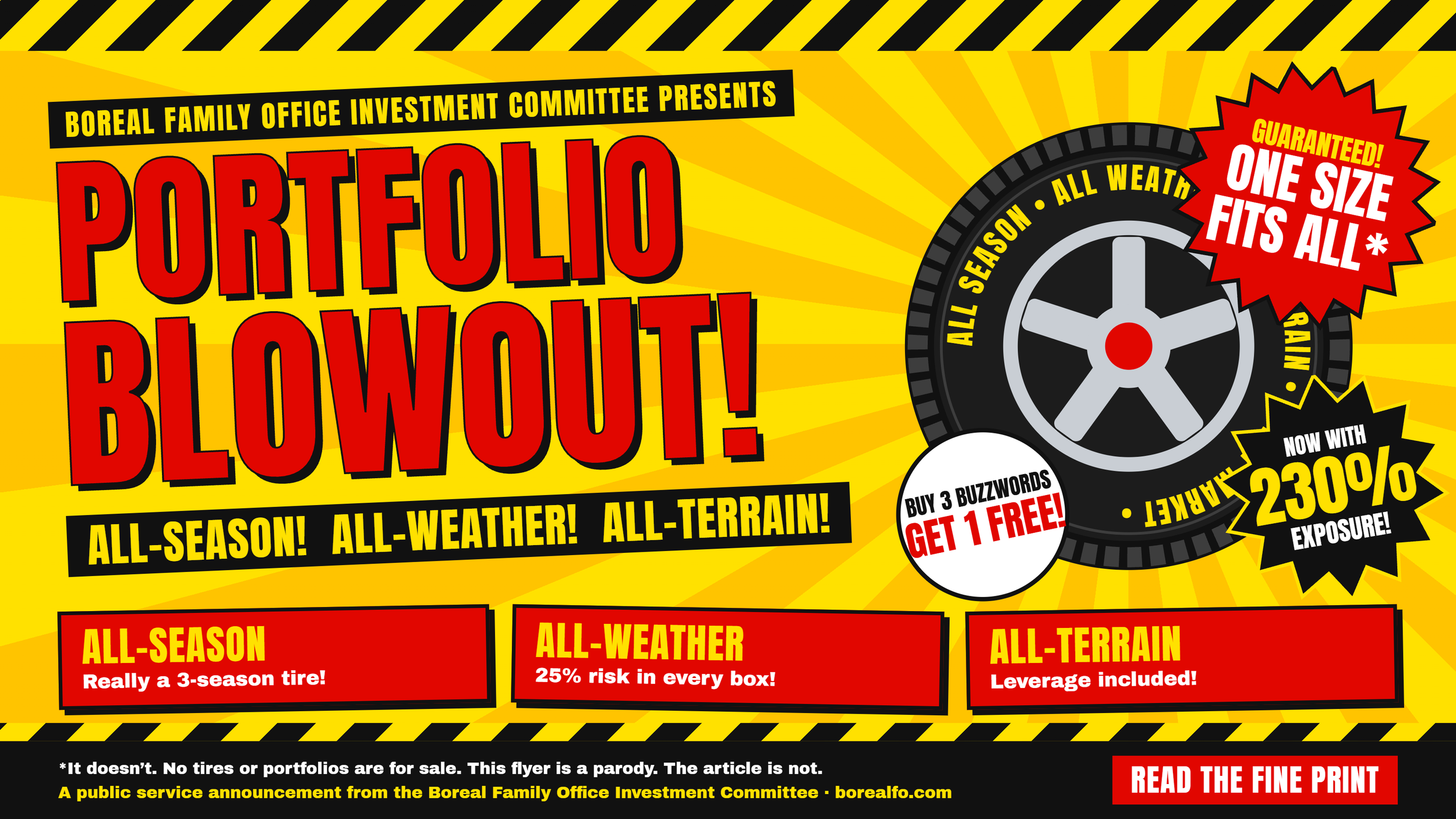
All season, all weather, all terrain. An editorial from the Boreal Family Office Investment Committee.
Every November, Canadian drivers stand in a tire shop and read three labels that sound like the same promise: all-season, all-weather, all-terrain. They are three different products, and one of them is a three-season tire with an optimistic name.
Investors now face the same aisle. “All Weather,” “All Terrain” and “All Seasons” portfolios are each sold as one set for every condition. This note separates the three, says plainly what is good and bad about each, and explains how this committee feels toward each one.
Of course, this is not investment advice, and you should not build your portfolio by relying on this editorial.
Part 1: Three labels on the tire wall
The three tire labels describe three different engineering compromises, and the name alone does not tell you which tire passed a winter test. The names were written by marketing departments; the three-peak mountain snowflake on the sidewall was earned in a traction test.
| Label | What the name suggests | What it is | What you give up |
|---|---|---|---|
| All-season | One tire for the whole year | A harder compound built for spring, summer and fall. It loses traction below 7°C and retailers themselves call it a “3-season” tire. | Winter grip |
| All-weather | The same thing, reworded | A compound that stays flexible above and below 7°C. It carries the three-peak mountain snowflake symbol, so one set can run all year in milder winters. | Peak performance at both ends: a dedicated winter tire still wins on ice and hard-packed snow |
| All-terrain | Go anywhere | A tread that balances paved roads with gravel, dirt and light snow. Many now carry the snowflake symbol too. | More road noise, more fuel and faster wear on pavement than a highway tire, and it is still not built for extremes |
Sources: Kal Tire (n.d.) for all-season, all-weather and winter tires; J.D. Power (2025) and SlashGear (2026) for all-terrain tires; Tire Rack (n.d.) for the snowflake symbol.
Two lessons carry over to investing. First, a label that promises “all” always hides a trade-off, and the useful question is which condition was sacrificed. Second, even a certification tests less than you think. The snowflake symbol measures acceleration on packed snow only. Braking, cornering and ice are not part of the test, and tires in several categories now clear the bar. Portfolios do not even have a sidewall symbol, so the investor has to do the testing.
Part 2: The All Weather portfolio
All Weather is the portfolio you hold when you accept that you cannot forecast, and it is the origin of what the industry now calls risk parity. Ray Dalio and his colleagues at Bridgewater Associates launched it in 1996, originally for Dalio’s own family trust (Bridgewater Associates 2012).
The idea fits on a napkin. Asset prices respond mainly to two things: growth and inflation, each coming in above or below what the market expected. That gives four environments. Hold a sub-portfolio that does well in each one, and give each the same amount of risk. Because bonds are less volatile than stocks, balancing risk rather than dollars usually means holding more bonds and applying moderate leverage.
Swipe sideways to see the full chart.
What is good about it
- It needs no prediction. The strategy is passive by design. In Bridgewater’s own account it was the best portfolio its founders could build without having to forecast future conditions.
- It fixes a real flaw. Bridgewater observed that a typical institutional portfolio held roughly 60% of its dollars in equities and, as a result, most of its risk. A 60/40 portfolio is one large bet that growth will beat expectations.
- It takes inflation seriously. Rising inflation hurts stocks and nominal bonds together. All Weather holds inflation-linked bonds and commodities for exactly that box.
What is bad about it
- It balances surprises, not time spent. Each box is defined relative to what markets expected, so when we interpret Bridgewater’s logic, the four are equally likely and each gets 25% of the risk. Part 4 (below) uses a different yardstick. It measures regimes by level and finds one benign regime covering about three quarters of the last 50 years. The two numbers should not be set against each other directly. The practical point survives: a portfolio balanced to surprises carries heavy protection through long benign stretches, and protection has a cost.
- It leans on bonds and leverage. Risk balance requires a large, levered bond position. That worked through four decades of falling inflation. In 2022, when inflation and interest rates rose together, Bridgewater’s All Weather fund lost 22%, more than its 20% loss in 2008 (Bloomberg News 2024; Markov 2023). A global 60/40 benchmark would have lost around 16.1% that year (Markov 2023).
- It never changes its tires. The allocation is the same in a boom and in a recession. That is the point of the design, and it is also the limit of it.
In tire terms, All Weather is the all-weather tire: one honest compromise, fitted year-round, never the best tire on the road on any given day.
Part 3: The All Terrain portfolio
All Terrain keeps the All Weather core and stacks liquid alternative strategies on top of it. The term is pushed most heavily by ReSolve Asset Management, a Toronto firm, in its paper From All-Weather to All-Terrain Investing for the Stormy Decade Ahead (ReSolve Asset Management 2023).
The argument starts from a fair criticism of Part 2. Commodities are a main inflation leg of an All Weather portfolio, and they are unreliable ballast. ReSolve notes that commodities returned 650% from 1970 through 1980 yet lost 37% from peak to trough in the middle of that run. Its answer is to add strategies that can go long and short: trend-following managed futures, systematic global macro, and a long-volatility tail hedge.
This is where much of the industry is heading. All Weather itself is now sold to the public as an exchange-traded fund, which State Street files under alternative investments (State Street Investment Management 2026). ReSolve’s own site promotes “return stacking” funds, including one that pairs bonds with managed futures. Managers who once sold balanced funds now sell liquid alternatives as the upgrade to a one-set-fits-all portfolio.
Swipe sideways to see the full chart.
What is good about it
- It adds return sources that do not depend on the direction of growth or inflation. ReSolve reports monthly correlations since 1990 of 0.14 between its All Weather proxy and trend following, and 0.17 with systematic macro.
- It can profit from falling prices. A long-only portfolio can only choose what to own. A trend strategy can be short.
- It names the tail risk. A dedicated hedge is a more direct answer to a crisis than hoping correlations hold.
What is bad about it
- It is a levered portfolio. The illustration holds about 230% notional exposure for every dollar invested. Leverage is a tool, and it also multiplies implementation error.
- The evidence is hypothetical. ReSolve labels its results as hypothetical and prepared with hindsight. Some component indices exclude fees and trading costs, and part of the trend-following history is simulated.
- A strategy is not an asset class. Trend-following indices exist, and ReSolve uses one, but each is an average of managers or a set of rules someone chose. Results depend on which rules or manager you pick, what they charge and whether they survive.
- Insurance has a premium. Tail hedges tend to cost money in the many years when nothing breaks.
- The author sells the product. ReSolve manages strategies of this kind. That does not make the research wrong, and a reader should weigh it.
In tire terms, All Terrain is the all-terrain tire: real capability off the pavement, paid for every day on it. It suits the driver who leaves the road often enough to justify the cost.
Part 4: One more buzzword, the All Seasons portfolio
All Seasons is usually treated as a synonym for All Weather, and there is a reason. Tony Robbins used the name in his 2014 book Money: Master the Game for a simplified recipe Ray Dalio gave him: 30% stocks, 55% Treasuries, 7.5% gold and 7.5% commodities (Robbins 2014; Team Tony n.d.). That portfolio is All Weather for the retail investor, a fixed recipe. We use the phrase for a different idea, and the difference is the argument of this note.
Weather is tomorrow’s surprise. A season is a persistent state with a known character and a typical length. All Weather says we cannot know what is coming, so we balance everything equally and permanently. All Seasons says the seasons are identifiable, unequal in length and different in character, so we build for each one and combine them on purpose.
The tire industry spoiled the word. An all-season tire is one compound pretending to cover four seasons. What we mean is what Canadian drivers actually do: keep a set for each season, and a rule for when to change.
| Portfolio | Tire equivalent | Core idea | Needs a view on the environment? | Main cost |
|---|---|---|---|---|
| All Weather | All-weather tire | Equal risk across four growth and inflation surprises, held permanently | No | Protection carried, and paid for, through long benign stretches |
| All Terrain | All-terrain tire | All Weather plus long/short and tail-hedge overlays | No | Leverage, fees, manager risk |
| All Seasons, strategic | Tires chosen for your own climate | A portfolio built for each regime, combined in fixed proportions by how likely and how risky each one is | Only on long-run frequencies | Thin data on the rare regimes |
| All Seasons, dynamic | A set per season and a changeover rule | The same building blocks, tilted toward the season you are in | Yes | Being wrong, or late, about the season |
Is it just about lower volatility? Yes and no
We want less volatility when markets are bearish. When markets are bullish we want to keep it, because large growth is volatility by another name.
The data make the distinction concrete. Over 1973 to 2023, US equities averaged a 14.9% annual return at 13.8% volatility in the benign regime. In downturns they averaged a 6.2% annual loss at 22.8% volatility. Volatility in a good season is the price of admission. Volatility in a bad season is risk with nothing attached.
A portfolio that suppresses volatility in every season hands back the good one. The chart below shows three static portfolios from the same study. The 60/40 portfolio wins the benign regime and is weak in the other three. The portfolio that spreads risk equally across regimes is the mirror image.
Swipe sideways to see the full chart.
No static mix leads in all four regimes. That is the trade the All Seasons idea tries to improve on.
One caveat comes from the same table. Per unit of risk, 60/40 was the weakest of the nine portfolios the authors test even in the benign regime: 1.33, against 1.49 for the equal-risk regime mix. An investor willing to use leverage could scale up the balanced portfolio instead, which is the risk parity answer. Our argument is for the investor who does not lever.
The concept: regime-based strategic asset allocation
The most rigorous statement of the idea we have read is a 2025 paper in the CFA Institute’s Financial Analysts Journal by Eric Bouyé and Jérôme Teiletche of the World Bank Treasury. They model returns as a mixture of regimes and ask how a long-term investor should use that information without market timing.
They define four US regimes from two tests. Growth is low during NBER recessions and high otherwise. Inflation is high when consumer prices are up more than 5% year over year and inflation is higher than a year earlier. The first finding is how unequal the seasons are.
Swipe sideways to see the full chart.
These are regimes measured by level. All Weather’s four boxes are surprises relative to expectations, so this chart is not a like-for-like test of its 25% risk budget. It shows where the economy spent its time.
The method then has two steps.
- Build the best portfolio for each season. For each regime, find the long-only mix with the best risk-adjusted return inside that regime.
- Combine the four. Weight them by capital or by risk, and either equally or by how often each regime occurs. Equal risk across regimes is close in spirit to All Weather. Weighting by frequency leans toward the benign regime.
The season portfolios differ sharply, which is the tire-wall lesson again.
Swipe sideways to see the full chart.
Tested out of sample from June 1998 to December 2023, with realistic data lags, the regime-based mixes held up against conventional methods. The equal-risk regime mix had the best Sharpe ratio of the nine portfolios (0.60, against 0.51 for 60/40) and the smallest maximum drawdown (17.0%, against 33.2%). These figures are from Table 7 of the paper.
We are brutally honest in our assessments, so the limits belong beside the results.
- The 60/40 portfolio still earned the highest return, 7.0% a year against 5.9% for the equal-risk regime mix. The regime-based advantage is in drawdown and risk-adjusted return, which is where a risk-first investor looks.
- The data are narrow. One country, seven asset classes, 611 months. Inflation-linked bonds before 1997 and commodities excluding gold before 1998 are backfilled estimates.
- Rare seasons are thinly sampled. Stagflation is about 5% of the sample, roughly 31 months. The authors name this as a limitation.
- It is a strategic paper. The authors never tilt toward the current regime. They do not claim to know the current season, and they do not need to.
So the problem is: which season are we in?
The weakness of the dynamic version is that you have to know the season, and markets do not announce it. With weather you can read a fairly accurate forecast, or walk outside and feel it. With tires the rule is a thermometer: change over at 7°C.
Capital markets offer neither. Prices move on conditions relative to what is already priced in, so they can adjust before you feel anything or read it in the news. Bridgewater’s own origin story makes the point. In August 1971 a young Ray Dalio heard Nixon suspend the dollar’s convertibility into gold and expected stocks to fall. The Dow rose almost 4% the next day (Bridgewater Associates 2012).
The official record is slower still. Bouyé and Teiletche note that NBER recession dates have been published between 4 and 21 months after the fact. In their out-of-sample test they replace them with a real-time rule based on unemployment data, and they acknowledge it does not match the official dates perfectly. By the time a recession is declared, the tires that mattered were the ones already on the car.
This is the question our Investment Committee spends its time on, and we hold three positions.
- The strategic mix must stand without a forecast. The regime-based research shows a season-aware portfolio can be held permanently and still be resilient. That is the floor.
- The season is a probability. We do not declare a regime. We assess how likely each one is, using rules and quantitative indicators, including what markets themselves are pricing. Headlines arrive last.
- Tilts are sized for being wrong. Any lean toward the current season is limited by what it costs if the season turns out to be a different one.
That is what we mean by risk-first, rules-based design for capital resilience.
What the best drivers do
None of these is a bad tire. All Weather is an honest answer to not knowing what comes next. All Terrain adds real capability for the investor who will use it. All Seasons asks for more judgment and rewards it when the judgment is sound. Each has merit, and each gives something up.
The best drivers do not argue about labels. They know the road they are about to drive, they know how the car behaves, and they change before the conditions arrive. Almost nobody fits winter tires on the shoulder in the first snowfall.
The label on a portfolio tells you what its seller hopes you will believe. The better questions are which season it was built for, which one it sacrifices, and who decides when to change the tires. Those are hard questions to answer about your own car.
References
Bloomberg News. 2024. “Investors in ‘Disappointing’ Funds Pioneered by Ray Dalio Demand Exit.” InvestmentNews, April 23, 2024. https://www.investmentnews.com/ria-news/investors-in-disappointing-funds-pioneered-by-ray-dalio-demand-exit/252561.
Bouyé, E., and J. Teiletche. 2025. “Regime-Based Strategic Asset Allocation.” Financial Analysts Journal 81 (4): 84-102. https://doi.org/10.1080/0015198X.2025.2558354.
Bridgewater Associates. 2012. “The All Weather Story.” January 2012. https://www.bridgewater.com/research-and-insights/the-all-weather-story.
J.D. Power. 2025. “All-Terrain and Mud-Terrain Tires: The Pros and Cons.” February 2025. https://www.jdpower.com/cars/shopping-guides/all-terrain-and-mud-terrain-tires-the-pros-and-cons.
Kal Tire. n.d. “What’s the Difference? All Weather vs All Season vs Winter Tires.” Accessed November 2026. https://kaltire.com/en/whats-the-difference-between-all-season-all-weather-and-winter-tires.html.
Markov, M. 2023. Analysis of risk parity fund performance. CAIA Association, December 2023. https://caia.org/node/7312.
ReSolve Asset Management. 2023. “From All-Weather to All-Terrain Investing for the Stormy Decade Ahead.” January 2023. https://investresolve.com/from-all-weather-to-all-terrain-investing-for-the-stormy-decade-ahead/.
Robbins, T. 2014. Money: Master the Game. New York: Simon & Schuster.
SlashGear. 2026. “5 Downsides of Using All-Terrain Tires.” August 2026. https://www.slashgear.com/2243076/downsides-of-using-all-terrain-tires/.
State Street Investment Management. 2026. “ALLW Brings Bridgewater’s All Weather Wisdom to ETF Investors.” February 2026. https://www.ssga.com/us/en/institutional/insights/allw-brings-bridgewaters-all-weather-wisdom-to-etf-investors.
Team Tony. n.d. “The End of the Bull Market.” tonyrobbins.com. Accessed November 2026. https://www.tonyrobbins.com/?p=3931.
Tire Rack. n.d. “What Is the Three-Peak Mountain Snowflake Symbol?” Accessed November 2026. https://www.tirerack.com/upgrade-garage/what-is-the-threepeak-mountain-snowflake-symbol.
This editorial is for general information and education. It is not investment advice and does not describe any client portfolio. Figures quoted from third-party research are historical or hypothetical, are drawn from the sources above, and have not been independently verified by Boreal. Past performance does not indicate future results.
Boreal Family Office, 49 Wellington St E #301, Toronto. borealfo.com
投资与轮胎有什么共同点?
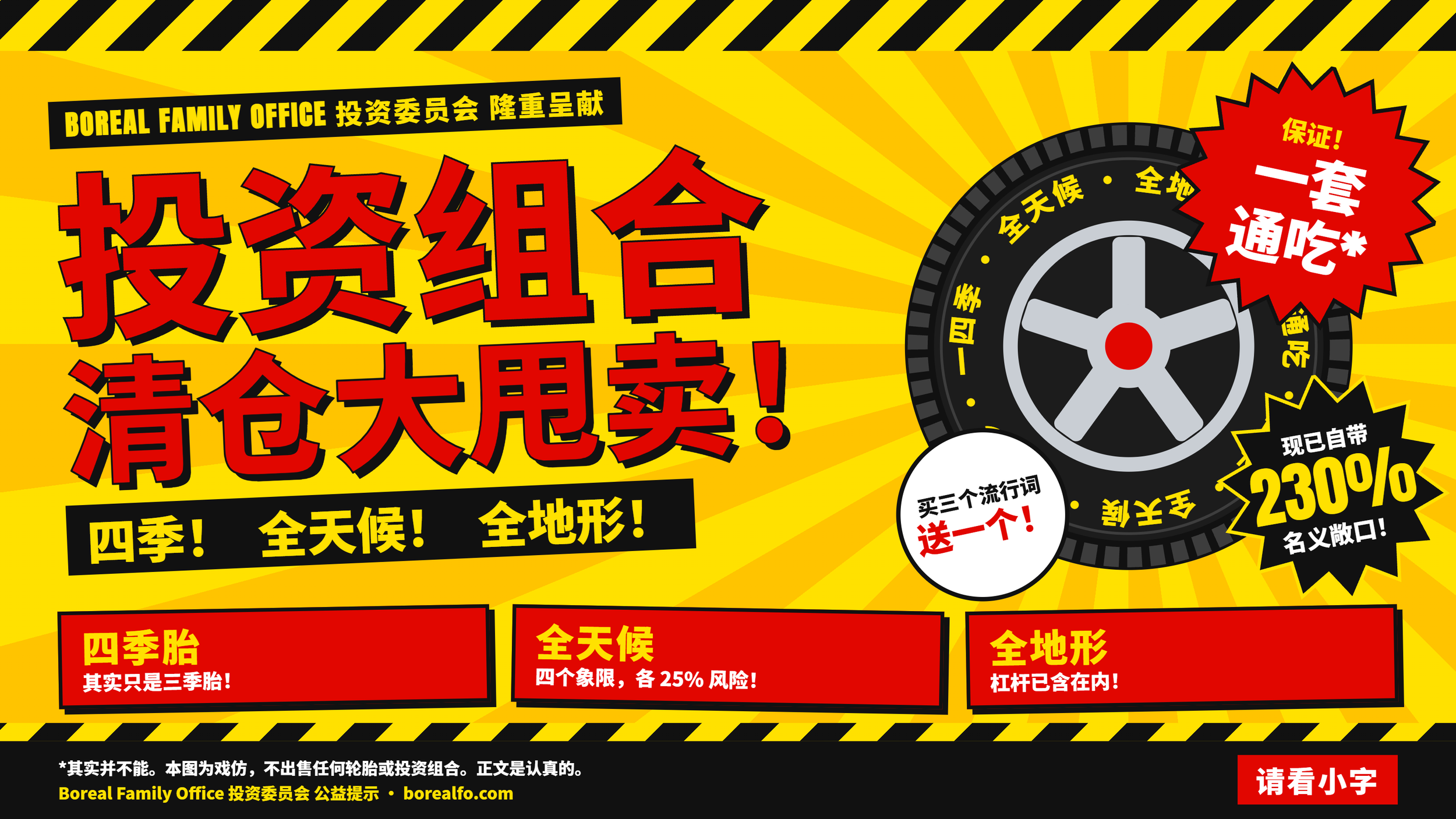
四季胎、全天候胎、全地形胎。Boreal Family Office 投资委员会评论。
每年十一月,加拿大的车主走进轮胎店,都会看到三个听起来像同一种承诺的标签:四季胎(all-season)、全天候胎(all-weather)、全地形胎(all-terrain)。它们其实是三种不同的产品,其中一种只是名字起得乐观的“三季胎”。
投资者如今面对的是同样的货架。“全天候”(All Weather)、“全地形”(All Terrain)和“四季”(All Seasons)投资组合,都被包装成一套应对所有路况的方案。本文把三者分开来讲,直说各自的长处与短处,并说明本委员会对每一种的看法。
当然,本文不构成投资建议,你不应依据这篇评论来构建自己的投资组合。
第一部分:轮胎墙上的三个标签
三个标签对应三种不同的工程取舍,光看名字,看不出哪一种通过了冬季测试。名字出自市场部;胎侧上的三峰雪花标志,则是在牵引力测试中挣来的。
| 标签 | 名字给人的印象 | 实际是什么 | 你放弃了什么 |
|---|---|---|---|
| 四季胎 | 一条轮胎用全年 | 胶料偏硬,为春、夏、秋三季设计。气温低于 7°C 时抓地力下降,连零售商自己都称它为“三季胎”。 | 冬季抓地力 |
| 全天候胎 | 同一个意思,换个说法 | 胶料在 7°C 上下都能保持柔软。胎侧带有三峰雪花标志,冬季较温和的地区可以一套用全年。 | 两端的极致表现:在冰面和压实的积雪上,专用冬季胎仍然更胜一筹 |
| 全地形胎 | 哪里都能去 | 胎纹兼顾铺装路面与碎石、泥土和薄雪。如今不少型号也带有雪花标志。 | 与公路胎相比,在铺装路面上噪音更大、油耗更高、磨损更快,而且仍然不是为极端路况而造 |
资料来源:四季胎、全天候胎与冬季胎见 Kal Tire(n.d.);全地形胎见 J.D. Power(2025)与 SlashGear(2026);雪花标志见 Tire Rack(n.d.)。
有两点可以直接搬到投资上。第一,凡是承诺“全”的标签,背后都藏着取舍,真正有用的问题是:被牺牲的是哪一种路况。第二,即便是认证,测试的内容也比你以为的少。雪花标志只测压实雪面上的加速牵引力,制动、过弯和冰面都不在测试范围内,如今好几个类别的轮胎都能过关。投资组合连胎侧标志都没有,测试只能由投资者自己来做。
第二部分:全天候投资组合
全天候(All Weather)是你承认自己无法预测时所持有的投资组合,也是业界如今所说“风险平价”的源头。瑞·达利欧(Ray Dalio)和他在桥水基金(Bridgewater Associates)的同事于 1996 年推出这一策略,最初是为达利欧自己的家族信托而设计(Bridgewater Associates 2012)。
它的思路一张餐巾纸就能写下。资产价格主要对两件事作出反应:增长与通胀,各自高于或低于市场原先的预期。由此得出四种环境。在每一种环境下各持有一个表现良好的子组合,并给每个子组合分配相同的风险。由于债券的波动低于股票,按风险而非按金额来平衡,通常意味着持有更多债券,并使用适度杠杆。
左右滑动可查看完整图表。
优点
- 不需要预测。 该策略在设计上就是被动的。按桥水自己的说法,这是其创始团队在无需预测未来环境的前提下所能构建的最佳组合。
- 它修正了一个真实的缺陷。 桥水观察到,典型的机构投资组合约有 60% 的资金配置于股票,其结果是大部分风险都来自股票。60/40 组合实质上是一笔押注增长将超出预期的大赌注。
- 它认真对待通胀。 通胀上行会同时打击股票和名义债券。全天候正是为这一象限持有通胀挂钩债券和大宗商品。
缺点
- 它平衡的是“意外”,而不是“时间”。 每个象限都以市场预期为基准来定义,因此按我们对桥水逻辑的理解,四者出现的可能性相同,各得 25% 的风险。第四部分(见下文)用的是另一把尺子:它按水平来划分经济状态,发现过去 50 年中约有四分之三的时间处于同一种温和状态。这两个数字不宜直接对比。但实际含义依然成立:一个针对意外而平衡的组合,在漫长的温和时期里背着厚重的保护,而保护是有成本的。
- 它依赖债券和杠杆。 风险平衡需要一个规模庞大、带杠杆的债券头寸。在通胀持续回落的四十年里,这一做法行之有效。2022 年通胀与利率同步上行,桥水全天候基金下跌 22%,超过其 2008 年 20% 的跌幅(Bloomberg News 2024;Markov 2023)。同年全球 60/40 基准的跌幅约为 16.1%(Markov 2023)。
- 它从不换胎。 无论繁荣还是衰退,配置都一样。这正是设计的初衷,也是它的局限。
用轮胎来比喻,全天候组合就是全天候胎:一个诚实的折中方案,全年不换,但在任何一天都不是路上最好的那条胎。
第三部分:全地形投资组合
全地形(All Terrain)保留全天候作为核心,再在其上叠加流动性另类策略。这一说法推得最用力的是多伦多的 ReSolve Asset Management,见其文章 From All-Weather to All-Terrain Investing for the Stormy Decade Ahead(ReSolve Asset Management 2023)。
它的论证从对第二部分的一条合理批评出发。大宗商品是全天候组合中对冲通胀的主力之一,却并不可靠。ReSolve 指出,1970 年至 1980 年间大宗商品累计回报 650%,但期间从峰值到谷底一度下跌 37%。它的对策是加入可以多空双向操作的策略:趋势跟踪型管理期货、系统化全球宏观,以及做多波动率的尾部对冲。
这正是业内不少机构的走向。全天候策略本身如今已作为交易所交易基金(ETF)面向公众发售,道富(State Street)将其归入另类投资(State Street Investment Management 2026)。ReSolve 自己的网站也在推广“回报叠加”(return stacking)基金,其中一只把债券与管理期货组合在一起。过去卖平衡基金的管理人,如今把流动性另类策略当作“一套通吃”组合的升级版来卖。
左右滑动可查看完整图表。
优点
- 它增加了不依赖增长或通胀方向的回报来源。 ReSolve 报告称,自 1990 年以来,其全天候代理组合与趋势跟踪的月度相关系数为 0.14,与系统化宏观为 0.17。
- 它可以从价格下跌中获利。 只做多的组合只能选择持有什么,趋势策略则可以做空。
- 它正面应对尾部风险。 与其寄望于相关性不变,专门的对冲是对危机更直接的回应。
缺点
- 这是一个带杠杆的组合。 示例中每投入一元,持有约 230% 的名义敞口。杠杆是工具,同时也会放大执行上的失误。
- 证据是假设性的。 ReSolve 自己注明其结果为假设性结果,并且是事后编制。部分成分指数未扣除费用和交易成本,趋势跟踪的部分历史数据来自模拟。
- 策略不等于资产类别。 趋势跟踪指数确实存在,ReSolve 也用了其中一个,但每个指数要么是若干管理人的平均,要么是某人选定的一套规则。结果取决于你选的规则或管理人、收费多少,以及它能否存活下来。
- 保险是有保费的。 在风平浪静的多数年份里,尾部对冲往往是亏钱的。
- 作者本身在卖这类产品。 ReSolve 管理的正是这类策略。这并不说明研究有错,但读者应当把这一点考虑在内。
用轮胎来比喻,全地形组合就是全地形胎:离开铺装路面时确有真本事,代价是在铺装路面上天天付出。它适合那些离开公路的次数多到值得付出这份代价的车主。
第四部分:再来一个流行词,四季投资组合
“四季”(All Seasons)通常被当作“全天候”的同义词,这是有原因的。托尼·罗宾斯(Tony Robbins)在 2014 年出版的 Money: Master the Game 一书中,用这个名字来称呼达利欧给他的一份简化配方:30% 股票、55% 美国国债、7.5% 黄金和 7.5% 大宗商品(Robbins 2014;Team Tony n.d.)。那是面向散户的全天候,一份固定的配方。我们用这个词指的是另一回事,而这个区别正是本文的论点。
天气是明天的意外。季节则是一种持续的状态,有已知的特征和大致的长度。全天候的逻辑是:我们无从知道接下来会发生什么,所以把一切均等地、永久地平衡起来。四季的逻辑是:季节可以识别,长短不一,性格各异,所以我们为每个季节分别构建组合,再有意识地把它们合在一起。
是轮胎行业把这个词用坏了。四季胎是用一种胶料假装覆盖四个季节。我们所说的“四季”,是加拿大车主真正在做的事:每个季节备一套轮胎,再加一条何时换胎的规则。
| 投资组合 | 对应的轮胎 | 核心思路 | 是否需要对环境有判断? | 主要代价 |
|---|---|---|---|---|
| 全天候 | 全天候胎 | 对增长与通胀的四种“意外”分配相同风险,永久持有 | 不需要 | 在漫长的温和时期背负保护,并为此付费 |
| 全地形 | 全地形胎 | 全天候加上多空策略与尾部对冲叠加 | 不需要 | 杠杆、费用、管理人风险 |
| 四季(战略型) | 按你所在的气候选的轮胎 | 为每种经济状态构建一个组合,按各状态的出现概率和风险大小以固定比例合成 | 只需判断长期频率 | 罕见状态的数据太少 |
| 四季(动态型) | 每季一套轮胎,加一条换胎规则 | 同样的积木,向当前所处的季节倾斜 | 需要 | 对季节判断错误,或判断太晚 |
只是为了降低波动吗?是,也不是
市场走熊时,我们希望波动小一些。市场走牛时,我们希望保留波动,因为大幅增长本身就是波动的另一个名字。
数据让这个区别变得具体。1973 年至 2023 年间,美国股票在温和状态下年均回报 14.9%,波动率 13.8%。在衰退状态下,年均亏损 6.2%,波动率 22.8%。好季节里的波动是入场的门票。坏季节里的波动则是没有任何回报相伴的风险。
一个在所有季节都压低波动的组合,等于把好季节拱手让出。下图是同一项研究中的三个静态组合。60/40 组合在温和状态下胜出,在另外三种状态下偏弱。把风险平均分配给各状态的组合则恰好相反。
左右滑动可查看完整图表。
没有哪一个静态组合能在四种状态下都领先。这正是四季思路想要改进的取舍。
同一张表里还有一点需要说明。按单位风险的回报来看,即便在温和状态下,60/40 也是作者测试的九个组合中最弱的:1.33,而等风险状态组合为 1.49。愿意使用杠杆的投资者可以转而把平衡型组合放大,这正是风险平价的回答。我们的论点针对的是不使用杠杆的投资者。
核心概念:基于经济状态的战略资产配置
在我们读过的文献中,对这一思路表述得最严谨的,是世界银行司库部(World Bank Treasury)的 Eric Bouyé 与 Jérôme Teiletche 于 2025 年发表在 CFA 协会 Financial Analysts Journal 上的论文 Regime-Based Strategic Asset Allocation。Regime 在学术上译作“区制”,本文称为“经济状态”。他们把回报建模为多种经济状态的混合,并追问:长期投资者如何在不做择时的前提下利用这一信息。
他们用两项标准划分出美国的四种经济状态。增长方面,美国国家经济研究局(NBER)认定的衰退期为低增长,其余为高增长。通胀方面,消费价格同比涨幅超过 5% 且高于一年前,即为高通胀。第一个发现,是四个季节的长短极不均等。
左右滑动可查看完整图表。
这些是按水平划分的经济状态。全天候的四个象限是相对于预期的“意外”,所以这张图并不能与它的 25% 风险预算直接对照。它展示的是经济把时间花在了哪里。
方法随后分两步。
- 为每个季节构建最优组合。 对每一种经济状态,找出在该状态下风险调整后回报最佳的纯多头组合。
- 把四个组合合在一起。 可以按资金或按风险加权,可以等权,也可以按各状态的出现频率加权。各状态等风险的做法,在精神上接近全天候。按频率加权则会向温和状态倾斜。
各个季节的组合差别悬殊,这又一次印证了轮胎墙上的道理。
左右滑动可查看完整图表。
在 1998 年 6 月至 2023 年 12 月的样本外测试中,并考虑了现实中的数据滞后,基于经济状态的组合与传统方法相比毫不逊色。在九个组合中,等风险状态组合的夏普比率最高(0.60,60/40 为 0.51),最大回撤最小(17.0%,60/40 为 33.2%)。以上数字出自论文表 7。
我们的评估向来直言不讳,所以局限应当与结果摆在一起。
- 60/40 组合的回报仍然最高, 年均 7.0%,等风险状态组合为 5.9%。基于经济状态的方法,优势在回撤和风险调整后回报,而这正是风险优先的投资者所看重的。
- 数据范围很窄。 一个国家,七类资产,611 个月。1997 年以前的通胀挂钩债券和 1998 年以前的黄金以外大宗商品,均为回填估算数据。
- 罕见季节的样本很少。 滞胀约占样本的 5%,大约 31 个月。作者自己也把这一点列为局限。
- 这是一篇战略层面的论文。 作者从不向当前状态倾斜。他们没有声称知道当前处于哪个季节,也不需要知道。
所以问题是:我们现在处于哪个季节?
动态型的弱点在于你必须知道当前的季节,而市场不会宣布。看天气,你可以查一份相当准确的预报,或者干脆走到户外感受一下。换轮胎,规则就是一支温度计:7°C 时换胎。
资本市场两样都不给。价格的变动取决于现实相对于已被计入价格的预期如何,所以在你有所感觉、或在新闻里读到之前,价格可能已经调整完毕。桥水自己的创业故事就说明了这一点。1971 年 8 月,年轻的达利欧听到尼克松宣布美元停止兑换黄金,以为股市会下跌。第二天,道琼斯指数上涨近 4%(Bridgewater Associates 2012)。
官方记录来得更慢。Bouyé 与 Teiletche 指出,NBER 的衰退日期是在事后 4 至 21 个月才公布的。在样本外测试中,他们改用一条基于失业数据的实时规则来代替,并承认它与官方日期并不完全吻合。等到衰退被正式宣布,真正起作用的,是当时已经装在车上的那套轮胎。
这正是我们投资委员会花时间研究的问题,我们有三点立场。
- 战略配置必须不靠预测也能站得住。 基于经济状态的研究表明,一个考虑了季节差异的组合可以长期持有,并依然具有韧性。这是底线。
- 季节是一个概率。 我们不去宣布当前处于哪种状态。我们依据规则和量化指标,包括市场自身的定价,评估每一种状态的可能性。新闻标题总是最后才到。
- 倾斜的幅度要按“判断出错”来定。 向当前季节的任何倾斜,都以“如果季节其实是另一个”时要付出的代价为限。
这就是我们所说的风险优先、规则为本、为资本韧性而设计。
最好的驾驶者怎么做
这三种都不是坏轮胎。全天候是对“不知道接下来会怎样”的一个诚实回答。全地形为真正用得上的投资者增加了实在的能力。四季要求更多的判断,判断得当时也会给予回报。各有长处,也各有所舍。
最好的驾驶者不会在标签上争论。他们知道自己将要开上什么路,知道这辆车的脾性,并在路况到来之前就把轮胎换好。几乎没有人会在第一场雪里停在路肩上换冬季胎。
投资组合上的标签,告诉你的是卖方希望你相信什么。更好的问题是:它是为哪个季节而造的,牺牲了哪个季节,以及由谁来决定何时换胎。对自己的车,这些问题并不容易回答。
参考文献
Bloomberg News. 2024. “Investors in ‘Disappointing’ Funds Pioneered by Ray Dalio Demand Exit.” InvestmentNews, April 23, 2024. https://www.investmentnews.com/ria-news/investors-in-disappointing-funds-pioneered-by-ray-dalio-demand-exit/252561.
Bouyé, E., and J. Teiletche. 2025. “Regime-Based Strategic Asset Allocation.” Financial Analysts Journal 81 (4): 84-102. https://doi.org/10.1080/0015198X.2025.2558354.
Bridgewater Associates. 2012. “The All Weather Story.” January 2012. https://www.bridgewater.com/research-and-insights/the-all-weather-story.
J.D. Power. 2025. “All-Terrain and Mud-Terrain Tires: The Pros and Cons.” February 2025. https://www.jdpower.com/cars/shopping-guides/all-terrain-and-mud-terrain-tires-the-pros-and-cons.
Kal Tire. n.d. “What’s the Difference? All Weather vs All Season vs Winter Tires.” Accessed November 2026. https://kaltire.com/en/whats-the-difference-between-all-season-all-weather-and-winter-tires.html.
Markov, M. 2023. Analysis of risk parity fund performance. CAIA Association, December 2023. https://caia.org/node/7312.
ReSolve Asset Management. 2023. “From All-Weather to All-Terrain Investing for the Stormy Decade Ahead.” January 2023. https://investresolve.com/from-all-weather-to-all-terrain-investing-for-the-stormy-decade-ahead/.
Robbins, T. 2014. Money: Master the Game. New York: Simon & Schuster.
SlashGear. 2026. “5 Downsides of Using All-Terrain Tires.” August 2026. https://www.slashgear.com/2243076/downsides-of-using-all-terrain-tires/.
State Street Investment Management. 2026. “ALLW Brings Bridgewater’s All Weather Wisdom to ETF Investors.” February 2026. https://www.ssga.com/us/en/institutional/insights/allw-brings-bridgewaters-all-weather-wisdom-to-etf-investors.
Team Tony. n.d. “The End of the Bull Market.” tonyrobbins.com. Accessed November 2026. https://www.tonyrobbins.com/?p=3931.
Tire Rack. n.d. “What Is the Three-Peak Mountain Snowflake Symbol?” Accessed November 2026. https://www.tirerack.com/upgrade-garage/what-is-the-threepeak-mountain-snowflake-symbol.
本评论仅供一般信息与教育之用,不构成投资建议,亦不描述任何客户的投资组合。文中引自第三方研究的数字为历史或假设性数据,均出自上述来源,未经 Boreal 独立核实。过往表现不代表未来结果。
Boreal Family Office,49 Wellington St E #301,Toronto。borealfo.com